

A bra-sized bodysuit can be worth comparing when clothing sizes do not describe your bust and underbust proportions clearly enough. Start with the band-and-cup information, then check the waist, hips and torso length separately. A familiar bra label is a starting point, not a guarantee that the whole bodysuit fits.
If you are choosing between a bra-sized and dress-sized bodysuit in the UK, the useful question is which chart accommodates your measurements with the fewest compromises. This guide focuses on that sizing decision. For integrated-support construction and general product selection, see our built-in-bra bodysuit guide.
What is a bra-sized bodysuit?
A bra-sized bodysuit uses a band-and-cup designation as part of its sizing. A dress-sized design instead starts with a clothing label, such as a UK number or S, M and L. The product's own chart explains how either system relates to the rest of the garment.
Band-and-cup information can be useful when your bust requires a different proportion from the one implied by a general clothing size. However, it does not by itself describe the waist, hips or shoulder-to-crotch fit. You still need those details before treating a size as a suitable option.
Do not assume that a product is conventionally bra-sized just because its selector includes a cup marking. Combined letter and cup labels need their own explanation. Read the actual chart rather than converting an unfamiliar label yourself.

When is a bra-sized bodysuit worth comparing?
Compare bra-sized options when clothing-sized bodies repeatedly leave you choosing between enough room at the bust and a suitable fit elsewhere.
Perhaps your bust measurement points towards one size while your waist points towards another. Perhaps moving up makes the upper body feel more comfortable but leaves the middle loose. Those are reasons to compare different proportions, not evidence that your body needs changing.
A more specific bust label may make the shortlist easier to assess. It still needs to be supported by clear body measurements. If a listing gives you a band and cup but no way to assess the waist or hips, ask for clarification before ordering.
A fuller bust is not the same thing as a larger clothing size. Equally, a plus-size label does not automatically indicate greater cup capacity relative to the band. Treat bust fit and body fit as related but separate requirements.
Start with measurements, not a familiar label.
Note your bust, waist and hips before comparing charts. A clear set of measurements makes it easier to spot where one size may not accommodate everything.
How do you read a dress-sized bodysuit chart?
Read across the bust, waist and hip measurements rather than selecting the letter or number you usually wear. The label alone cannot establish how the garment is proportioned.
Write down which option each measurement suggests. If all three fall within one size, that gives you a straightforward starting point, although length and construction still matter. If the measurements point towards different sizes, record that mismatch instead of ignoring the least convenient one.
A chart that lists only waist and hips leaves an important question unanswered for a garment expected to fit over the bust. Stretch is not a precise measurement, and a product photograph cannot tell you how much room the chest has.
Use our shapewear measuring guide to prepare the body measurements. Follow any additional instructions supplied with the particular product you are comparing.

What if your bust and waist point to different sizes?
Look for the product's own guidance before deciding to size up or down. Neither approach universally solves a mismatch.
Going up may create more room through the chest while changing the waist, hips and length too. Going down may give a closer waist fit while leaving the bust compressed or the body pulling. Check the whole chart before deciding that either trade is acceptable.
If a size accommodates your bust but clearly misses the rest of your measurements, compare another cut or sizing system. Repeating the same proportions under a different colour name is unlikely to resolve the underlying issue.
Do not buy a smaller label for stronger shaping. Your aim is a garment whose intended measurements fit you, not one that makes one area look smooth while another becomes uncomfortable.
Do combined letter and cup markings equal UK bra sizes?
Not automatically. Treat them as product-specific until the retailer explains the intended measurements and any conversion.
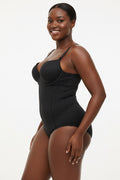
For example, our Seamless Shapewear Bodysuit with Built-in Bra uses letter sizes with C/D markings. Those markings should not be treated as proof that every fuller-bust measurement is accommodated, or that the garment offers independently selectable band-and-cup combinations.
If that is the option you are considering, ask us to clarify the intended measurements rather than assuming a UK bra-size equivalent.
This is an example of why chart-reading matters, not a claim that the product is suitable for every fuller bust. Integrated support describes a feature; sizing information still has to establish the fit you need.

Comparing this integrated-support option?
Read its product-specific size information alongside your measurements. Ask about any unclear label rather than treating C/D markings as an exact UK bra-size conversion.
Why check torso length after band and cup fit?
A bodysuit joins the upper and lower sections. Matching the circumference measurements does not guarantee that the distance between them suits you.
Check the product's length information and measuring method where supplied. Height alone is not enough: people of the same height can have different torso proportions.
During a careful try-on, notice whether the closure pulls, the neckline is dragged down or fabric gathers through the middle. Check seated fit as well as standing fit. The body should not have to pull on the bust section to reach the crotch comfortably.
Adjustable straps or closures can offer flexibility only where they are actually included and within their intended range. They do not establish that one length will fit everyone. Our sculpting bodysuit fit guide covers wider one-piece fitting checks.

When is a separate bra and shaping layer more practical?
Consider separating the jobs when no one-piece chart gives you a workable match for bust, waist, hips and length together.
An open-bust garment allows you to choose the bra independently, but the shaping garment still needs its own body measurements checked. You can compare our Open Bust Shapewear Bodysuit on that basis. Do not choose its body size from your bra label alone.
If you only want lower-body smoothing, a separate brief removes the bust-fitting question entirely. Our High Waist Tummy Control Knickers are an option to compare, checking the rise against your outfit.
Separates are not a lesser result. They can simply be a more practical way to accommodate two sets of measurements without forcing one garment to do everything.
What should you confirm before ordering?
Record the exact selectable option, the chart measurements supporting it and any unanswered conversion or length question. Check that the combination you need is actually offered; a range's headline size span does not establish every individual option.
Read the current delivery information and returns conditions, including hygiene requirements for intimate garments. Ask about unclear sizing before ordering several labels on an assumption.
At try-on, check ordinary sitting, breathing and movement. A chart match is a starting point, not a reason to ignore discomfort. Stop wearing a garment if it causes pain, numbness or difficulty breathing.

Prefer to choose your bra separately?
An open-bust style is another construction to compare. Check the shaping garment's own measurements and how its opening fits around your bra.
Questions about bra-sized bodysuit sizing
Is bra-sized always better than dress-sized for a fuller bust?
No. A clearly explained clothing-size chart may accommodate your proportions. Bra sizing is worth comparing when broad clothing labels do not describe your band-and-cup needs clearly enough.
Can I use my usual bra size to choose the whole bodysuit?
Use it as a reference, then check the product's own sizing system and its waist, hip and length information. The bra label does not describe the whole body.
Should I size up if my bust is outside the chart?
Check the next option across every relevant measurement first. If it solves the chest but makes the rest unsuitable, compare a different cut rather than accepting the mismatch.
Does a C/D marking confirm an exact UK size conversion?
No. Read the product-specific conversion guidance and ask about unclear labels before ordering.
Choose clear measurements over a familiar label
The useful sizing system is the one that lets you assess your actual proportions. Check band and cup information, body measurements and torso length separately, then decide whether the garment accommodates them together.
Keep broad support comparisons with our built-in-bra guide. For this decision, a clear chart and an honest fit check matter more than the most ambitious shaping promise.


0 comments